
Is Wan 2.5 Open Source? Understanding Alibaba's Strategic Shift
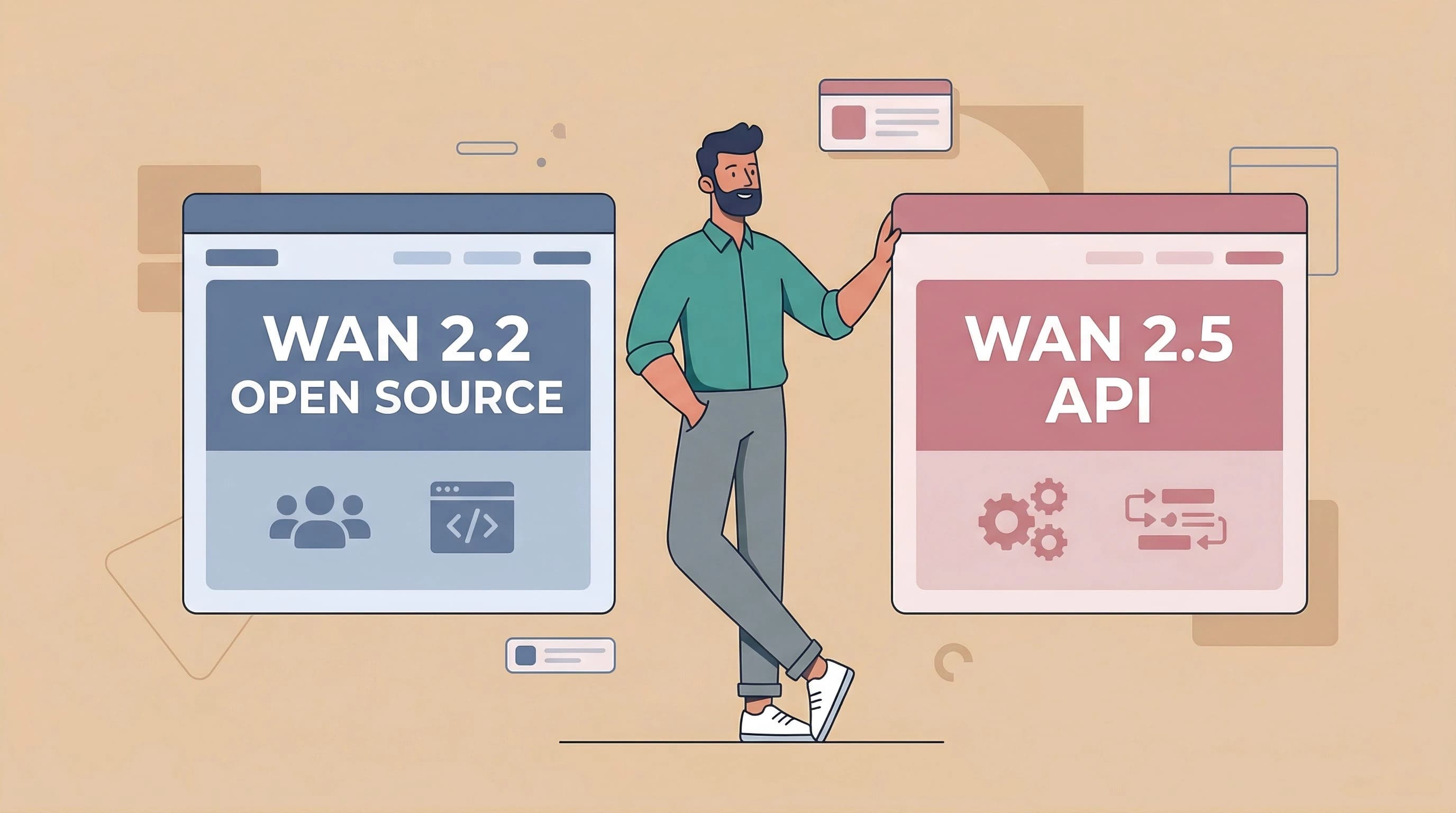
When Alibaba released Wan 2.1 and 2.2 under Apache 2.0, the AI community celebrated another win for open-source video generation. But if you're looking for Wan 2.5 or 2.6 on GitHub, you won't find them. This isn't an oversight—it's a deliberate strategic pivot that reveals how AI companies are rethinking the economics of open source.
Executive Summary
Wan 2.5 and 2.6 are not open source. They're distributed exclusively through Alibaba Cloud APIs, marking a clear departure from the Apache 2.0 model used for Wan 2.1 and 2.2. This article examines:
- Why the technical evolution from 2.2 to 2.5 made API-first distribution inevitable
- A decision framework for choosing between open-source 2.2 and API-based 2.5/2.6
- How Wan's approach compares to Stability AI and Meta's strategies
- What this signals about the future of open-source AI
Part I: The Technical Evolution That Changed Everything
From 1.3B to Multimodal: Understanding the Capability Jump
The progression from Wan 2.1 to 2.6 isn't just incremental improvement—it represents fundamental architectural shifts:
Wan 2.1 (Feb 2025)
- Model size: 1.3B parameters (T2V variant)
- Capability: Text-to-video generation
- Output: Silent video clips
- Inference: Feasible on consumer GPUs (24GB VRAM)
Wan 2.2 (Jul 2025)
- Model size: 5B parameters (TI2V variant)
- Capability: Text + image to video
- Output: Higher quality, still silent
- Inference: Requires professional GPUs (40GB+ VRAM)
Wan 2.5/2.6 (Sep 2025 onwards)
- Model size: Undisclosed (likely 10B+)
- Capability: Multimodal (text, image, audio synchronization)
- Output: Video with synchronized audio
- Inference: Requires distributed GPU clusters
Why Audio-Video Sync Changed the Game
The addition of synchronized audio in Wan 2.5/2.6 isn't just a feature—it's an architectural complexity multiplier:
- Computational cost: Audio-visual alignment requires joint training across modalities, increasing training costs by an estimated 3-5x
- Inference complexity: Real-time sync demands coordinated generation pipelines that are difficult to optimize outside controlled environments
- Quality control: Misaligned audio-video outputs create poor user experiences, requiring extensive post-processing and validation
This complexity makes self-hosting economically impractical for most users. A model that requires 8x A100 GPUs for acceptable inference latency isn't "open source" in any meaningful sense for 99% of developers.
The Self-Hosting Reality Check
Let's calculate the real cost of running Wan 2.2 (the last open-source version) at scale:
Hardware requirements for production deployment:
- Minimum: 2x A100 (80GB) = ~$20,000 hardware cost
- Recommended: 4x A100 for redundancy = ~$40,000
- Enterprise: 8x A100 cluster = ~$80,000
Operational costs (annual):
- Power consumption: ~$15,000-30,000/year (depending on utilization)
- Cooling and infrastructure: ~$5,000-10,000/year
- DevOps/ML engineering: ~$150,000/year (1 FTE)
- Total: ~$170,000-220,000/year
Break-even analysis: If Alibaba Cloud charges $0.10 per video generation, you'd need to generate 1.7-2.2 million videos annually to justify self-hosting. That's ~4,800-6,000 videos per day.
Part II: Decision Framework for Developers
Scenario 1: Prototyping and Small-Scale Projects (<1,000 videos/month)
Recommendation: Wan 2.5/2.6 API
Why:
- Zero infrastructure investment
- Access to latest features (audio sync, higher quality)
- Estimated cost: $100-500/month
- Time to first video: <1 hour
Trade-offs:
- API dependency and potential rate limits
- Data passes through Alibaba's infrastructure
- Subject to pricing changes
Scenario 2: Production Applications (10,000-100,000 videos/month)
Recommendation: Evaluate both options carefully
Wan 2.2 Self-Hosting makes sense if:
- You have existing GPU infrastructure
- Data privacy is critical (healthcare, legal, enterprise)
- You need custom model fine-tuning
- Your use case doesn't require audio
Wan 2.5/2.6 API makes sense if:
- You need audio-video capabilities
- Your team lacks ML infrastructure expertise
- You want to avoid capital expenditure
- Scaling flexibility is more important than cost optimization
Critical calculation: At 50,000 videos/month, API costs (~$5,000/month) start approaching self-hosting operational costs. This is your decision inflection point.
Scenario 3: Research and Customization
Recommendation: Wan 2.2 (only viable option)
Why:
- APIs don't allow model architecture modifications
- Research requires reproducibility and version control
- Academic use often has budget constraints but access to institutional compute
- Fine-tuning on domain-specific data requires weight access
Reality check: If your research requires 2.5/2.6 capabilities, you'll need to either:
- Collaborate directly with Alibaba
- Use API outputs as a baseline for comparison
- Wait for potential future open release (uncertain)
Part III: Three Models for "Open" AI—A Strategic Comparison
The AI industry is converging on three distinct approaches to balancing openness with commercial viability. Understanding these models reveals why Wan chose its path.
Model A: Generational Segmentation (Alibaba Wan)
Strategy: Keep previous generations fully open-source; distribute cutting-edge versions via APIs
Wan's implementation:
- Wan 2.1/2.2: Apache 2.0, GitHub repos, Hugging Face weights
- Wan 2.5/2.6: API-only via Alibaba Cloud Model Studio
Advantages:
- Maintains open-source credibility and community goodwill
- Captures enterprise revenue from users needing latest capabilities
- Reduces support burden (API users can't break the model)
- Controls abuse and misuse of most powerful versions
Disadvantages:
- Creates two-tier ecosystem (hobbyists vs enterprises)
- Research community stuck on older generations
- Risk of community fragmentation
Model B: Tiered Licensing (Stability AI)
Strategy: Release model weights publicly but with revenue-based licensing restrictions
Stability's implementation:
- Stable Video Diffusion: Weights on Hugging Face
- License: Free for research and <$1M revenue; enterprise license required above threshold
- Updated July 2024 after SD3 Medium community backlash
Advantages:
- Weights accessible for research and small businesses
- Clear monetization path for high-revenue users
- Maintains "open weights" positioning
Disadvantages:
- Enforcement challenges (how to track revenue?)
- Legal complexity across jurisdictions
- Not truly "open source" by OSI definition
Model C: Permissive with Use Restrictions (Meta Llama)
Strategy: Fully open weights with acceptable use policy and scale restrictions
Meta's implementation:
- Llama models: Weights freely available
- License: Permissive but restricts companies with >700M monthly active users
- Targets: Prevents direct competition (Google, Microsoft using Llama against Meta)
Advantages:
- Maximum accessibility for developers
- Strong community adoption and ecosystem
- Positions Meta as AI infrastructure provider
Disadvantages:
- No direct monetization from model itself
- Potential misuse harder to control
- Competitors benefit from Meta's R&D investment
Comparative Analysis
| Dimension | Wan (Generational) | Stability (Tiered License) | Meta (Permissive) |
|---|---|---|---|
| Weights access | Old versions only | All versions | All versions |
| Revenue model | API services | License fees + API | Indirect (ecosystem) |
| Community reach | Medium | High | Highest |
| Abuse control | Strong (API gating) | Medium (license terms) | Weak (honor system) |
| Research impact | Limited to old versions | Full access | Full access |
| Commercial clarity | Clear (pay for API) | Complex (revenue tracking) | Simple (just use it) |
Why Wan Chose Generational Segmentation
Alibaba's approach makes strategic sense given its position:
- Cloud infrastructure advantage: Unlike Meta (social) or Stability (pure AI), Alibaba has massive cloud infrastructure to monetize
- Chinese market dynamics: Domestic users prefer integrated cloud services; international users get open-source goodwill from 2.1/2.2
- Competitive positioning: Competes with AWS Bedrock and Google Vertex AI, not with open-source community
- Cost structure: Video generation is more expensive than text/image, making API economics more favorable
Part IV: What This Means for the Future
The End of Unconditional Open Source AI?
The pattern is clear: as AI models become more capable and expensive, companies are finding ways to monetize while maintaining some level of openness. Pure Apache 2.0 releases of frontier models are becoming rare.
What's driving this shift:
- Training costs: Wan 2.5/2.6 likely cost $10M+ to train; companies need ROI
- Inference economics: Video generation costs 100-1000x more than text generation
- Competitive pressure: OpenAI's Sora is closed; open alternatives need sustainable business models
- Abuse concerns: Deepfakes and misinformation make unrestricted access risky
Predictions for the Next 12-24 Months
Likely scenarios:
- More generational segmentation: Expect other companies to adopt Wan's model—open-source N-1 generation, API-only for latest
- Consolidation around three models: Generational (Wan), tiered licensing (Stability), permissive (Meta)
- Rise of "open weights" terminology: Companies will avoid "open source" and use "open weights" to describe restricted releases
- Academic access programs: Vendors will create special programs for researchers to access latest models
Unlikely scenarios:
- Return to unconditional Apache 2.0 for frontier models
- Complete closure of all model weights (community backlash too strong)
- Government regulation forcing open releases (too early in policy cycle)
Practical Recommendations for Developers
If you're starting a new project today:
- Prototype with APIs first: Validate your use case with Wan 2.5/2.6 API before committing to infrastructure
- Design for portability: Abstract your video generation layer so you can swap providers
- Monitor the 50K threshold: Track your monthly volume; reassess self-hosting when you approach 50,000 videos/month
- Keep Wan 2.2 as fallback: Maintain capability to fall back to self-hosted 2.2 if API pricing changes unfavorably
If you're already using Wan 2.2:
- Don't migrate unless you need audio: Silent video use cases don't benefit from 2.5/2.6
- Calculate your break-even: Use the formula above to determine if API makes economic sense
- Test quality differences: Run A/B tests to see if 2.5/2.6 quality improvements justify the cost
Conclusion: Open Source Isn't Binary
The question "Is Wan 2.5 open source?" reveals a deeper truth: openness in AI exists on a spectrum, not as a binary state.
Wan's approach is pragmatic, not cynical. By keeping 2.1 and 2.2 fully open while distributing 2.5/2.6 via APIs, Alibaba maintains community goodwill while building a sustainable business. For most developers, Wan 2.2 remains powerful enough for production use. For those needing cutting-edge capabilities, the API path is clear and economically rational.
The real question isn't whether Wan 2.5 is open source—it's whether the open-source model can survive in an era of $10M+ training runs and massive inference costs. Based on current evidence, the answer is: only for previous-generation models.
As developers, we need to adapt our expectations. "Open source AI" increasingly means "last year's model is open; this year's model is an API." That's not ideal, but it's better than nothing—and it might be the only sustainable path forward.
Appendix: Common Questions
Q: Can I find Wan 2.5 weights on Hugging Face from third parties?
A: Some third-party repos claim to offer Wan 2.5, but they typically have unclear licenses, incomplete weights, or are unauthorized conversions. Only trust official Wan-AI organization releases. As of March 2026, no official Wan 2.5/2.6 weights exist on Hugging Face.
Q: Will Alibaba eventually open-source Wan 2.5/2.6?
A: Unknown. However, the pattern suggests they may open-source 2.5 once 2.7 or 3.0 launches. The generational model means "open source" is always one generation behind.
Q: How does this compare to OpenAI's Sora?
A: Sora is completely closed with no self-hosting option. Wan's approach is more open—you can still use Wan 2.2 with full control. The comparison makes Wan look relatively developer-friendly.
Q: What about commercial use of Wan 2.2?
A: Fully permitted under Apache 2.0. You can use it commercially, modify it, and deploy it without restrictions or revenue thresholds.
References and Further Reading
Primary sources:
- Wan-Video GitHub Organization - Official repositories for Wan 2.1 and 2.2
- Wan-AI on Hugging Face - Official model weights
- Alibaba Cloud Model Studio API Documentation - Wan 2.5/2.6 API reference
Comparative analysis:
- Stability AI License Overview - Community License details
- Meta Llama License - Permissive with use restrictions