
On this page
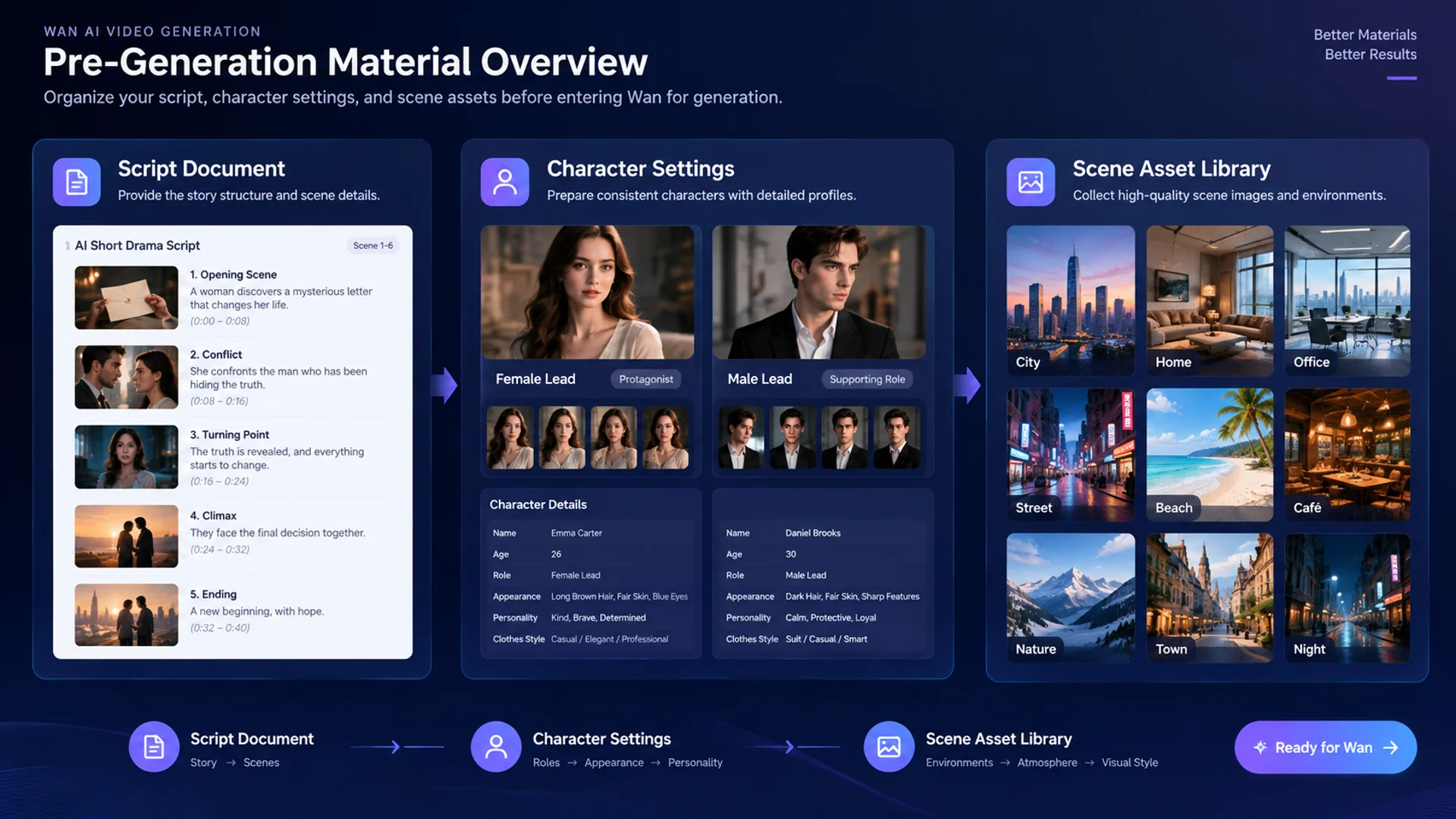
The most useful lesson from Huangguo-style AI video production is not that one powerful model can generate an entire episode. It is that a longer video becomes manageable when production is divided into reusable assets, planned shots, and replaceable generations.
A publicly shared breakdown of a Huangguo video makes this production logic visible. The finished episode is assembled from many short shots, each with its own character, setting, composition, movement, and audio requirements. Wan is therefore not responsible for producing the whole story at once. It enters when a planned shot needs to become video.
This guide focuses on that Wan layer: how T2V, I2V, and S2V serve different shots; where LoRA and local deployment become useful; and how Wan 3.0 can reduce some of the handoffs in an older Wan production pipeline.
The central idea is simple: Wan generates production units, while the surrounding system determines whether those units remain consistent, editable, and useful in the final episode.
The Huangguo Breakdown Reveals a Shot-Based Wan Pipeline
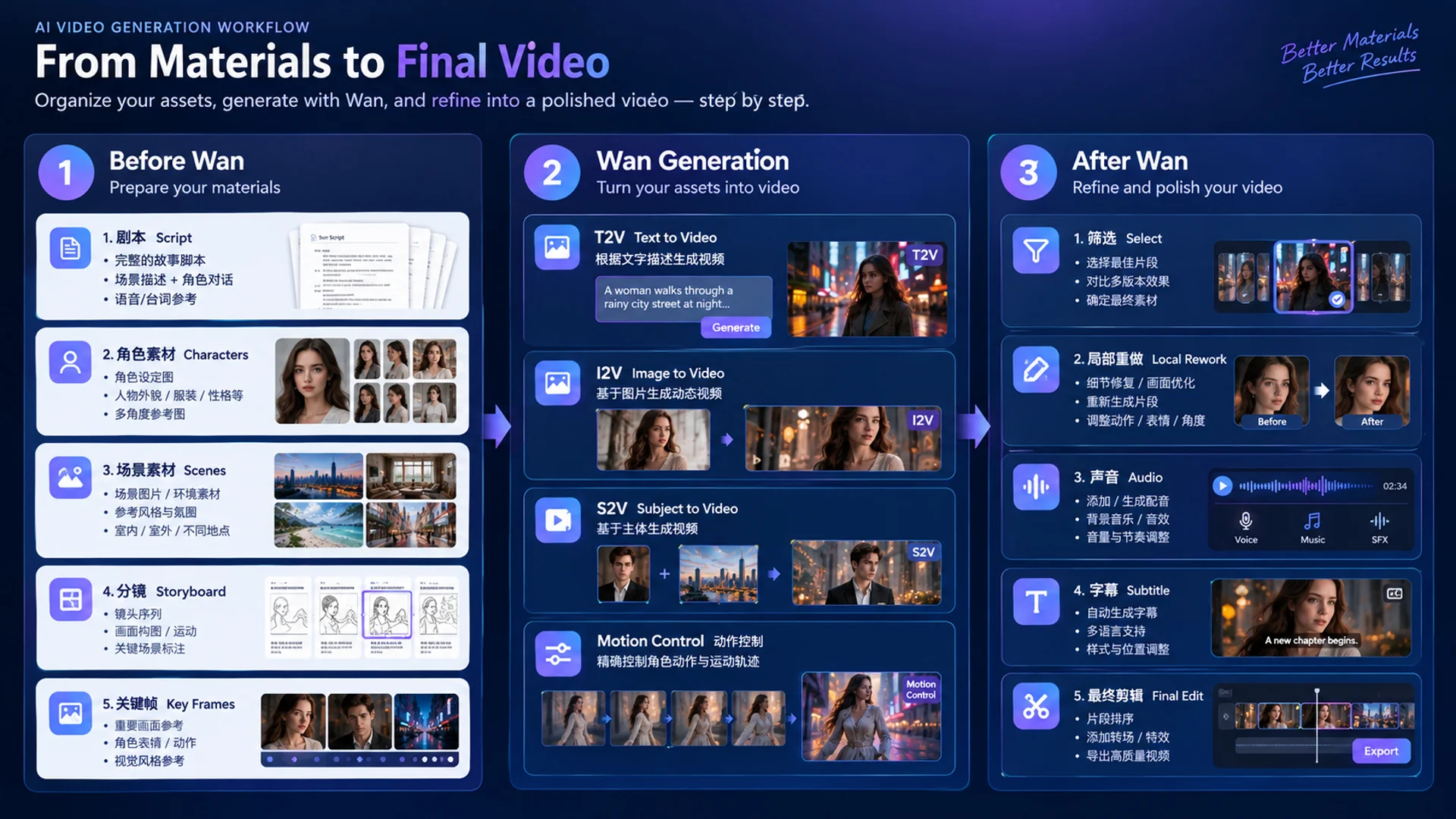
The 13-stage breakdown can be reduced to three production layers.
Before Wan, the story is divided into shots. Characters are defined through reference sheets or reusable LoRAs. Locations are organized into repeatable states such as interior, exterior, day, night, and different lighting conditions. An image model then creates a keyframe for each controlled shot, followed by manual selection and repair.
Inside the Wan layer, different shots take different routes. The analysis assigns ordinary visual shots to Wan T2V or I2V, dialogue and performance shots to Wan S2V or a lip-sync process, and specialized NSFW shots to a compatible fine-tuned Wan model or LoRA. Difficult movement may receive additional pose, video, or motion guidance.
After Wan, failed shots return to the relevant stage instead of forcing a full episode regeneration. Accepted clips move through visual finishing, sound, subtitles, and editing.
This is why the shot statistics matter. A three-to-eight-second unit is easier to replace than an eight-minute result. The cost is organizational: every shot needs the correct character state, wardrobe, location, framing, action, audio, and continuity notes. The model generates footage, but the production system decides whether that footage belongs in the episode.
What Must Be Ready Before a Shot Reaches Wan
A Wan prompt should describe the change that happens inside a shot. It should not carry the entire memory of the production. Four assets need to exist before repeated generation becomes reliable.
A Reusable Character Source
A single attractive portrait is not a complete character asset. A useful character sheet establishes the face from several relevant angles, hairstyle, recognizable features, body proportions, and baseline wardrobe. Additional expression or wardrobe references can be stored separately and selected only when a shot needs them.
This source library gives I2V, R2V, keyframe generation, and LoRA training a shared visual definition. It does not guarantee identical results, but it prevents each shot from rebuilding the character from a fresh paragraph of text.
Controlled Location States
The Huangguo breakdown specifically describes reusable scene templates. A bedroom at night and the same bedroom in daylight should be recorded as two states of one location, not invented independently. Approved views should preserve major props, entrances, windows, light direction, and the spatial relationship between characters and furniture.
A Shot Record
Each shot needs a small production record: who appears, which character and location states apply, what action occurs, whether the camera moves, what must match the previous shot, and which Wan route should receive it. This record becomes more important than a long prompt once several generations are being reviewed at the same time.
An Approved Keyframe
For an I2V shot, the keyframe carries composition, subject placement, wardrobe, environment, and initial expression. Fixing a face, hand, prop, or layout before animation is usually more efficient than preserving the flaw through several seconds of video.
These assets are not extra decoration around the model. They are the information Wan needs in order to generate one useful production unit.
Where Wan Enters: T2V, I2V, S2V, and Specialized Shots
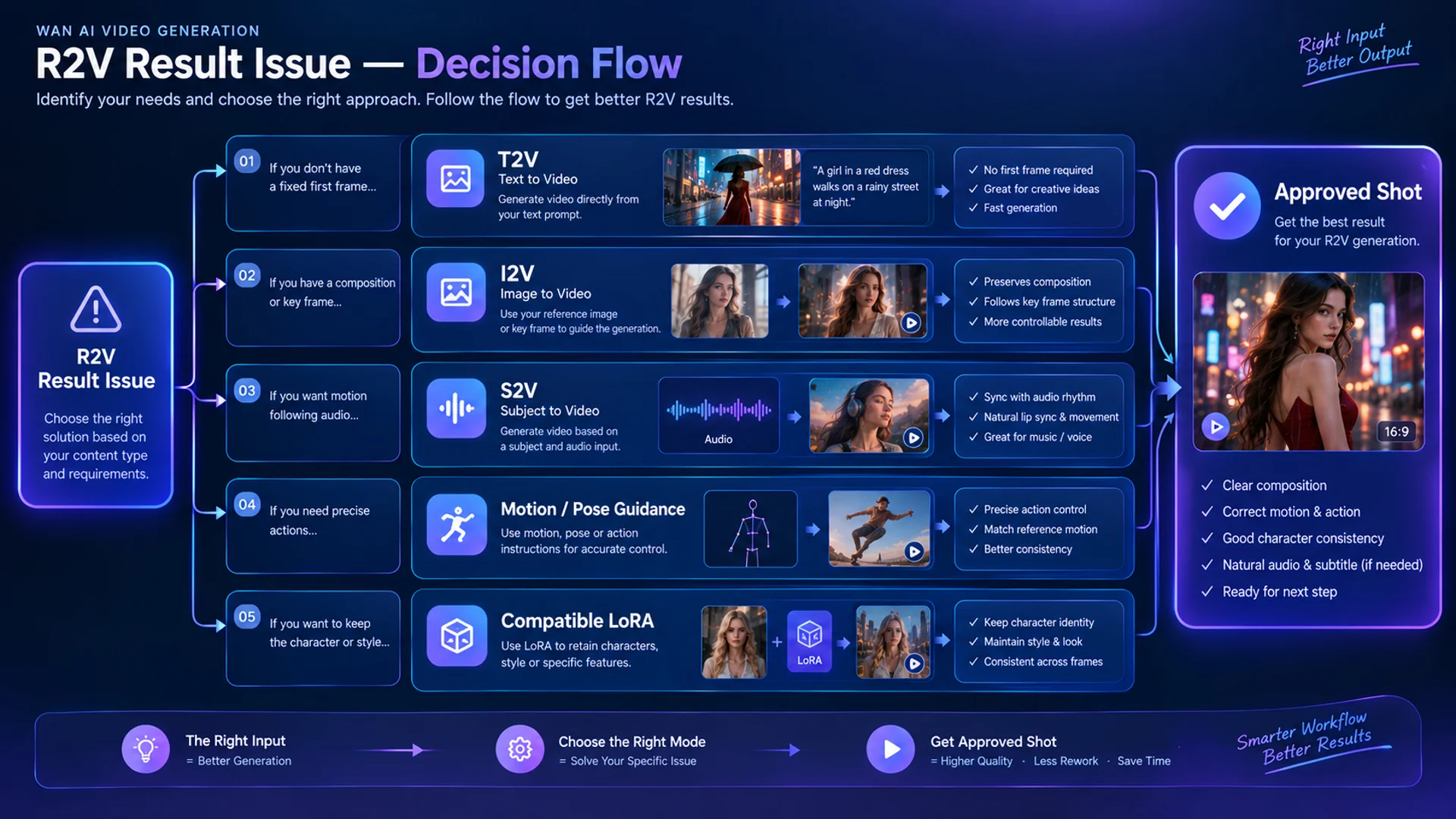
Wan first enters after the shot has been planned. The correct route depends on how much of that shot is already fixed. A loose establishing shot can begin with text. A controlled character shot begins with an image. A speaking shot adds audio as a timing source. A recurring specialized requirement may justify a compatible LoRA or fine-tune.
Use Wan T2V When the Shot Can Still Be Invented
Text-to-Video is suitable when no exact opening image must be preserved. In Huangguo-style production, this can include an establishing view, transition, atmospheric insert, object shot, or wide composition where the overall mood matters more than a precise recurring face.
T2V can discover a composition that was not already designed in a keyframe, but room geometry, wardrobe, facial details, and props may also change. Use that freedom selectively in a continuity-sensitive series.
Use Wan 2.2 I2V When the Keyframe Has Already Been Approved
Image-to-Video is the main workhorse suggested by the Huangguo analysis. Once an image has passed character, wardrobe, location, and composition checks, I2V turns that approved state into motion. The image supplies the starting frame; the prompt defines the action, camera behavior, pacing, and details that should remain stable.
This route is appropriate for a recognizable character at a known location, a planned two-person composition, or a close-up whose lighting and expression have already been accepted. It reduces the amount of information Wan must invent, but it does not lock every pixel. Large body movement, occlusion, camera rotation, physical contact, and multiple overlapping subjects can still produce identity or anatomy drift.
The inferred Huangguo pattern uses many clips in roughly three-to-eight-second units. That is a production choice, not a universal Wan limit. Its value is focus: a prompt that asks for several actions, a camera orbit, a wardrobe change, and another character entering gives the model competing jobs.
Use Wan2.2-S2V-14B When Audio Must Drive the Performance
Dialogue introduces a signal that ordinary I2V does not fully control: the character’s timing needs to follow speech or music. Wan2.2-S2V-14B is a Speech-to-Video route that combines a reference image and audio to generate facial expression, lip movement, body performance, and timing around the sound. The official implementation can also accept text and optional pose-video guidance.
This is different from basic lip-sync. Lip-sync normally starts with an existing video and adjusts the mouth to match speech. S2V generates a new performance around the audio. It is more useful when voice rhythm should influence the head, face, posture, or broader movement; lip-sync remains efficient when an accepted clip only needs mouth correction.
The reverse-engineered chart cannot confirm which method was used for every Huangguo dialogue shot. Its important insight is the routing decision: speaking shots should not automatically pass through the same silent I2V process as every other clip.
Add Motion Guidance Only to the Shots That Need It
Some actions are too specific to describe reliably with text. A motion-reference video, pose sequence, depth guide, or Wan Animate route can provide stronger temporal direction. This is useful when the production cares about the path of an action rather than only the opening pose.
More guidance is not automatically better. A keyframe, motion source, character LoRA, and dense prompt can disagree about body position or camera direction. Add one control because it solves one observed failure, then test it before combining another.
Reserve a Fine-Tuned Wan or LoRA for Repeated Specialized Needs
The chart separates specialized NSFW shots from ordinary T2V, I2V, and dialogue generation. It describes a fine-tuned Wan or LoRA route without identifying a confirmed checkpoint. The defensible conclusion is therefore about architecture: a custom model layer is introduced only where the base route repeatedly falls short.
This keeps one difficult requirement from controlling the whole episode. T2V can still create open shots, I2V can animate approved keyframes, and S2V can handle audio-driven performance. A compatible fine-tune or LoRA is added only for the identity, style, motion tendency, or NSFW behavior that needs reinforcement.
Why Wan LoRA and Local Deployment Matter
In Huangguo AI episodic production, the important question is not whether a LoRA can improve one shot. It is whether a recurring identity, visual treatment, or specialized behavior appears often enough to justify the cost of training, testing, and maintaining it.
A reusable LoRA moves part of that work out of individual prompts and into a versioned production asset. Once a character appears across dozens of shots, repeatedly repairing identity drift can cost more than preparing a clean dataset and validating one compatible adaptation.
LoRA is worth considering when:
- The same character must survive many locations, angles, and lighting conditions.
- Reference images work in simple views but repeatedly drift in new compositions.
- A recognizable visual treatment must remain consistent across an episode or series.
- A specialized behavior recurs across many shots.
LoRA is not the first answer to every inconsistency. A better keyframe, simpler blocking, or stronger reference selection may solve a short project with less work. It also cannot decide where two characters stand, preserve an exact room layout, or assign the correct action to each subject. Incompatible base models, inconsistent training images, and excessive strength can introduce new artifacts.
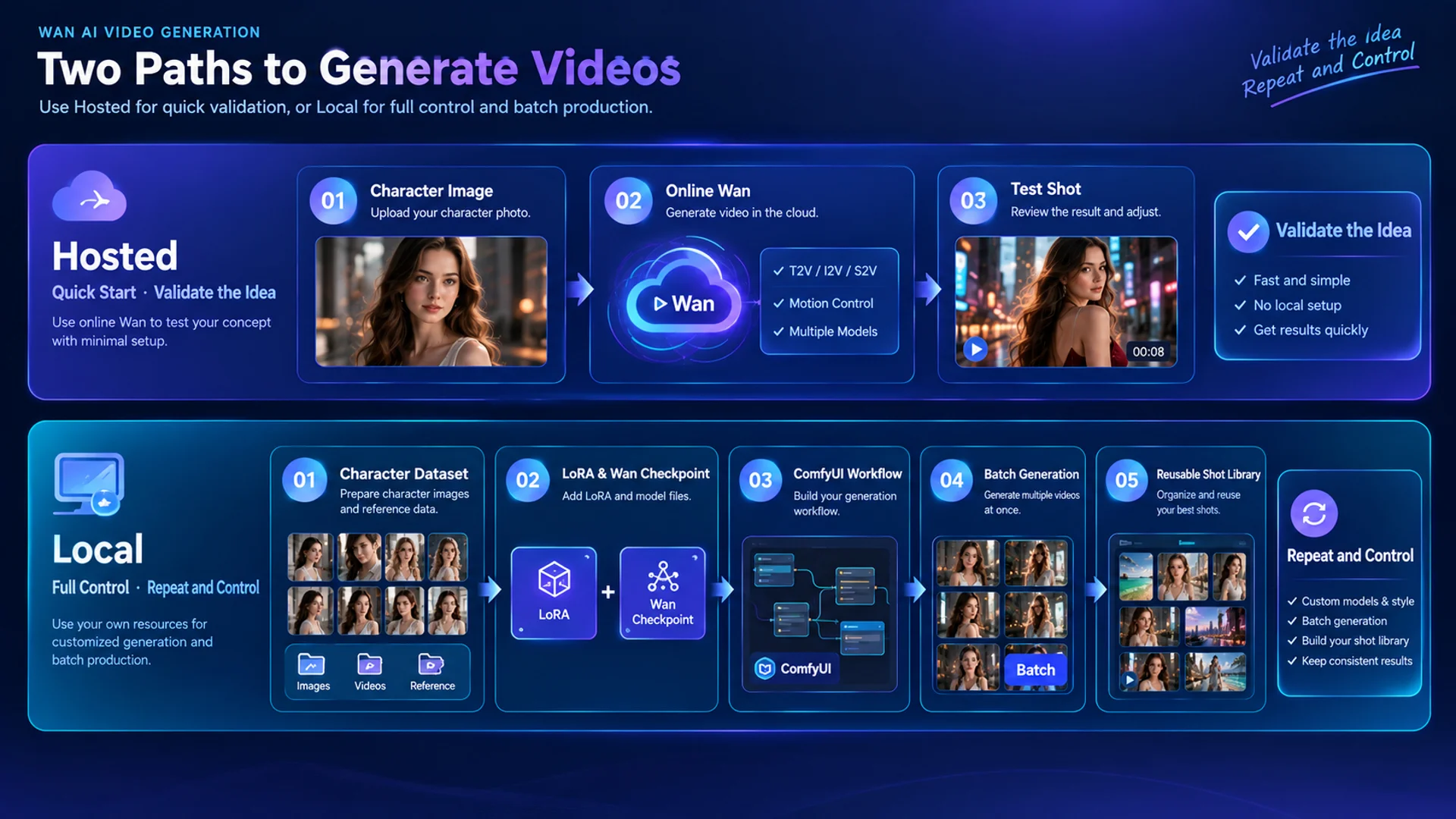
A hosted Wan generator hides checkpoint storage, GPU setup, and node configuration. It is efficient for testing a story, visual direction, or small set of I2V shots before committing to a local system. Creators can validate that production direction with an Wan 2.2 NSFW route before building the local stack.
Local deployment means running the checkpoint on controlled hardware. It exposes the parts a hosted interface may not provide: a specific Wan checkpoint, compatible LoRAs, fixed ComfyUI graphs, repeatable seeds and settings, batch variants, custom nodes, and automated post-processing around generation.
The official Wan 2.2 repository separates t2v-A14B, i2v-A14B, ti2v-5B, s2v-14B, and Animate routes. They are not interchangeable labels, and a LoRA or graph built for one architecture should not be assumed to work with another. Local control exposes that compatibility chain, but it also makes the production responsible for maintaining it.
The Huangguo diagram sketches studio-scale configurations involving two or four RTX PRO 6000 Blackwell 96GB GPUs and a distributed multi-machine option. Those examples should not be read as universal Wan requirements. They represent an inferred throughput target. Actual hardware depends on the route, checkpoint size, precision, quantization, frame count, resolution, offloading, and workflow implementation.
The practical threshold is operational. Stay hosted while the script, character design, and visual language are still changing. Move local when custom LoRAs, reproducible graphs, batch generation, or integration with a larger production system save more time than environment maintenance consumes.
Generate for the Edit, Not for the Demo
A beautiful clip is not automatically an editable shot. Huangguo AI Video production works only when generation and review are organized around the final timeline.
Generate in small scene groups and validate the cheapest layer first. Confirm that the character and location can produce a usable keyframe. Animate one limited action. Add dialogue, motion guidance, another character, or a specialized LoRA only after the simpler version is stable. This order reveals which layer caused the failure.
Review every clip for identity, anatomy, action, environment, timing, and editability. A result may look impressive in isolation but still fail because the wardrobe changes, the action begins too early, the room reverses direction, or the clip provides no clean entrance or exit for the adjacent shot.
Rebuild only the responsible layer:
- Wrong composition: repair or replace the keyframe.
- Identity drift: improve the selected reference or test a compatible LoRA.
- Confused movement: simplify the action or isolate a motion guide.
- Detached speech: return to the S2V, source audio, or lip-sync stage.
- Merged characters: simplify blocking or divide the moment into separate shots.
- Strong clip with one weak section: trim it, edit it, or regenerate only the missing beat.
Post-production then turns separate model outputs into one story. The chart includes upscaling, deflickering, frame-rate conversion, color correction, sound, subtitles, interface graphics, effects, and editing. Its observation of repeated-frame traces is consistent with some footage being converted from 24fps to a 30fps timeline, but that cannot identify one Wan model by itself. Wan routes and implementations do not all share the same output rate.
The useful production metric is not generations per hour. It is approved, editable shots delivered to the timeline. A model that produces more clips but creates additional identity repair, sound correction, or continuity work may not improve total output.
How Wan 3.0 Could Upgrade This Production Pipeline
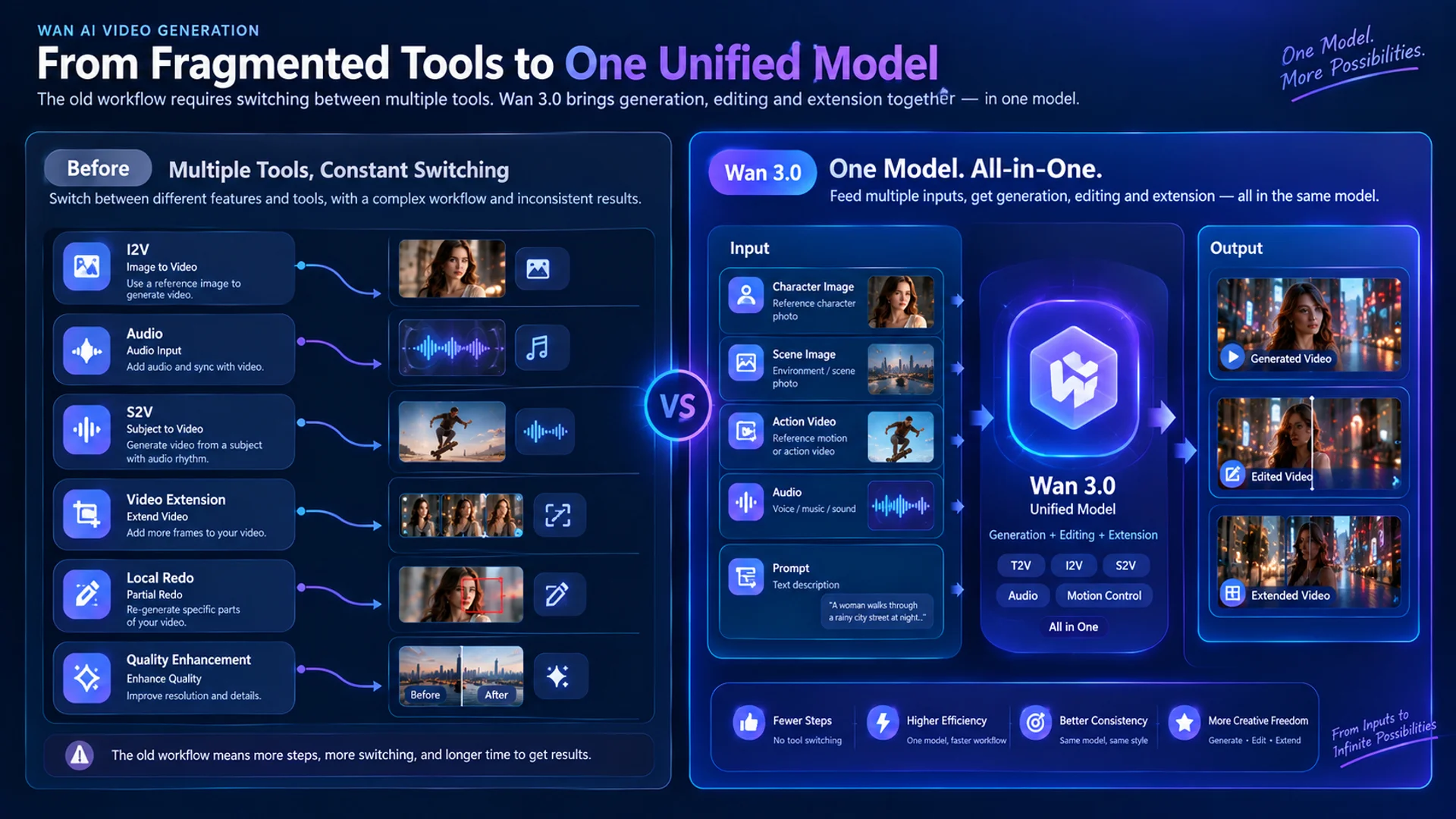
The Huangguo breakdown is organized around Wan 2.x-style routes and a specific finished video. Wan 3.0 does not invalidate that method, but it changes which steps a new production still needs to keep separate.
Wan 3.0 combines T2V, first-frame and first-last-frame I2V, multimodal R2V, native audio-video generation, video editing, and extension in one model. It supports up to 30-second output at 480p, 720p, or 1080p and 30fps. It can accept images, videos, audio, a document, or a public web page as references. These specifications create several practical upgrades to the older production line.
A Reference Package Can Reach the Video Model Directly
In a Wan 2.2-centered process, character identity, environment, motion, and sound often pass through separate assets and routes. Wan 3.0 can combine up to 10 reference images, five videos, and five audio clips in one generation request. A production can therefore provide a character image, location reference, movement example, and voice or music source together.
This does not remove the need for an asset library. It changes what that library can do. Instead of using references only to prepare a keyframe, selected assets can guide the generated video directly. The production still needs to assign each source a clear role; a larger reference set can create more conflicts if several files disagree about identity, composition, movement, or style.
Native Audio Can Reduce Dialogue Handoffs
Wan 3.0 can generate dialogue, sound effects, and music with the video. For a speaking shot whose exact voice performance has not already been locked, this may reduce the chain from silent I2V to separate voice generation and lip-sync.
It does not make Wan 2.2 S2V irrelevant. S2V remains useful when an existing audio performance must drive timing or when the production relies on a local, controllable speech-driven route. Wan 3.0 is most valuable when the sound and picture can be designed together rather than when the video must obey one fixed recording.
Longer Output Should Be Used Selectively
Native 30-second generation creates room for a complete exchange, continuous camera move, or longer performance. But the Huangguo analysis found a median shot length of only 3.2 seconds. Converting every short shot into a 30-second generation would weaken the very modularity that makes failures replaceable.
The better use is selective consolidation. Keep reaction shots, inserts, and continuity-sensitive cuts short. Use longer generations where an uninterrupted performance, camera move, or interaction would be harder to rebuild from several separate clips.
First-Last Frames, Editing, and Extension Can Save Accepted Work
First-last-frame control gives the production a defined visual start and destination. Video editing can change elements, style, lighting, or dialogue in an existing clip, while extension can continue forward, backward, or in both directions within the model’s duration limit.
These tools change the failure decision. A strong clip with a weak ending may be extended or edited instead of discarded. A missing reaction can potentially be added around accepted footage. This reduces full regeneration, although every repair still needs continuity review.
1080p and 30fps Can Reduce, Not Eliminate, Finishing
Wan 3.0’s 1080p and 30fps output can reduce the need for upscaling or frame-rate conversion on shots generated through that route. It does not remove color matching, sound leveling, subtitles, pacing, or final assembly. Mixed-model footage may still arrive with different motion texture, sharpness, and delivery settings.
Wan 3.0 Still Works Best as Part of a Hybrid Stack
Wan 3.0 can absorb more of the production process through multimodal references, native audio, longer output, editing, and extension. That makes it a strong route for regular shots, reference-guided scenes, and targeted repairs without rebuilding several separate generation stages.
It does not remove the value of a local Wan 2.2 pipeline when production depends on custom character LoRAs, specialized NSFW behavior, fixed S2V inputs, versioned checkpoints, repeatable ComfyUI graphs, or batch-level control. These are production-system requirements rather than individual generation features.
A practical setup can therefore remain hybrid: use Wan 3.0 NSFW where its unified inputs and editing tools reduce handoffs, while keeping a compatible local Wan 2.2 route for the shots that require custom model assets or exact node-level control.
Final Takeaway: Huangguo Shows Why Wan Needs a Production System
The Huangguo analysis replaces the idea of a secret eight-minute video model with a more credible production method: reusable characters and locations, approved keyframes, short Wan generations, specialized routes for speech or difficult shots, targeted regeneration, and deliberate post-production.
Wan’s role begins when a planned shot becomes a generation task. T2V provides visual freedom, I2V preserves an approved opening composition, and S2V lets audio drive the performance. A compatible LoRA reinforces identities or specialized behaviors that must survive repeated use, while local deployment turns these components into a reproducible production system.
The LoRA, S2V, and ComfyUI routes discussed here belong to separate local or community Wan workflows. They are not features provided inside the hosted Wan 2.2 NSFW generator.
Wan 3.0 can absorb more of the production system through multimodal references, native audio, editing, extension, 1080p output, and selective 30-second scenes. This can reduce several handoffs in the older production line, but it does not remove the need for asset preparation, shot planning, review, and final editing.
Before building a local stack, test the production logic with one establishing shot, one controlled I2V or R2V character shot, and one dialogue-driven shot.
Start with Wan 3.0 NSFW when multimodal references, native audio, editing, or extension are central to the scene.
Use the hosted Wan 2.2 NSFW route to validate basic T2V or I2V shot behavior before investing in a separate local setup.
If the production requires a compatible LoRA, S2V, or ComfyUI pipeline, treat it as a separate local workflow rather than a feature of the hosted generator.
Creators who have not chosen a model can review the available Wan routes before deciding which parts of the production require hosted generation and which require local control.