Kling 4.0 and Wan 3.0 appear close on a specification sheet. Both reach 30-second generation, accept multiple forms of reference material, generate native audio, and support more than a simple one-prompt video workflow.
The practical difference is how they give creators control.
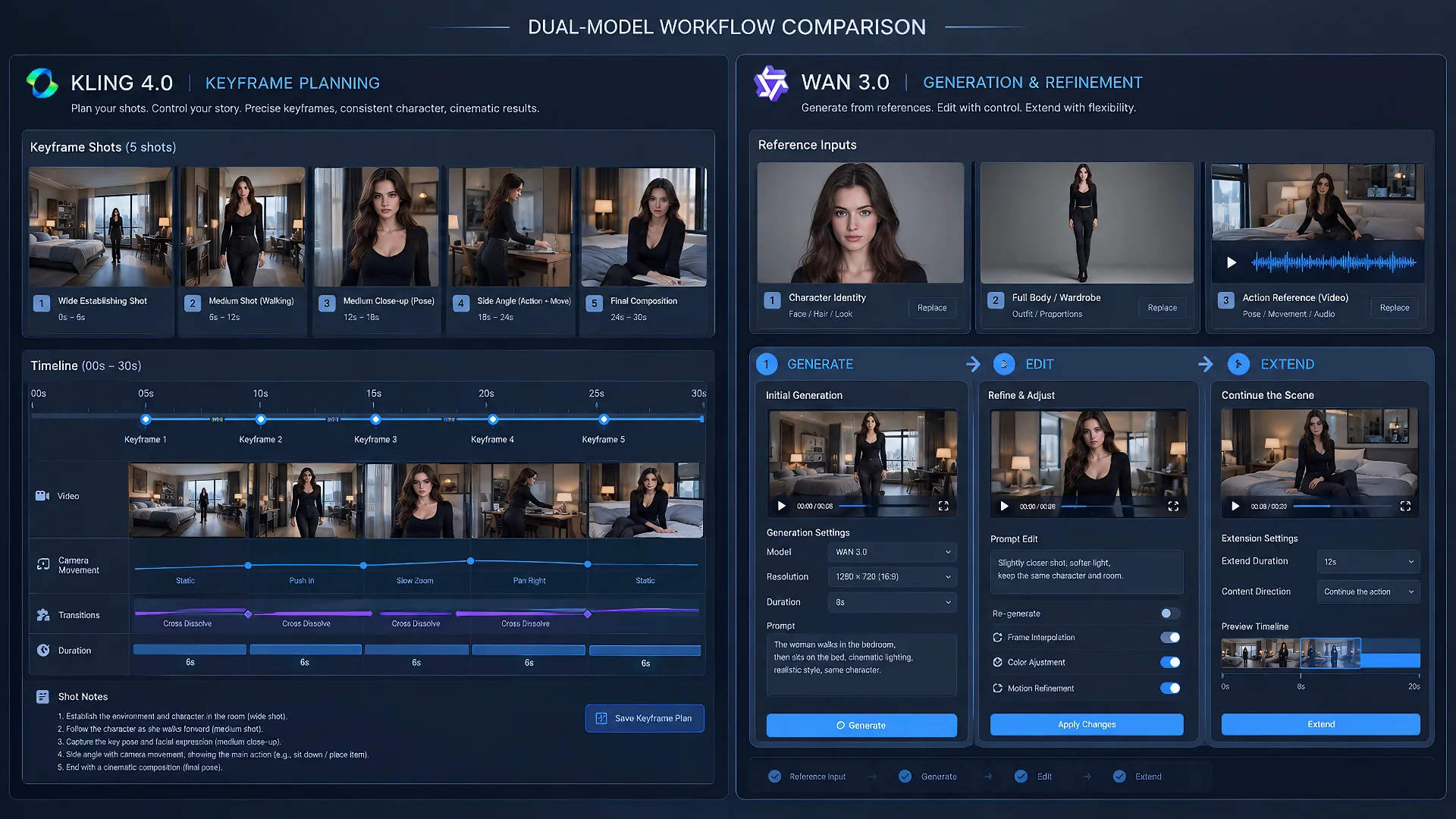
Kling 4.0 is built around planned direction. Its announced system supports up to 10 keyframes and as many as 15 multimodal references, giving creators more opportunities to define what should happen at important moments across a scene.
Wan 3.0 is built around a unified production workflow. It accepts text, images, video, audio, documents, and web links, then supports generation, editing, and extension within the same model family. On NSFWWan, it is already available through an uncensored NSFW workflow.
That creates a straightforward pre-release decision: wait for Kling 4.0 when multi-keyframe direction or native 4K HDR could materially change the project; use Wan 3.0 now when NSFW access, multimodal creation, editing, or extension matters more than waiting for an unreleased model.
Quick Decision
Use Wan 3.0 now if:
- You need an available NSFW video workflow rather than a future release.
- You already have a character image, motion example, audio reference, or existing clip.
- You expect to revise or extend the result after the first generation.
- 1080p is sufficient for the intended platform.
- Mature source material and prompts need to reach the model without a broad mainstream content filter.
Wait and test Kling 4.0 if:
- Up to 10 planned keyframes would solve a real scene-control problem.
- Native 4K and 10-bit HDR are delivery requirements.
- Multilingual dialogue, accents, or improved lip sync are central to the project.
- The project is compatible with Kling’s actual content policy at release.
- You can rebuild and retest the workflow once the full model becomes available.
Current status: Kling 4.0 Flash is in limited early access, while the full model is expected in October 2026. Wan 3.0 is available now. Flash results should not be treated as final Kling 4.0 results.
Kling 4.0 vs Wan 3.0 at a Glance
| Workflow Question | Kling 4.0 | Wan 3.0 |
|---|---|---|
| Can I use it now? | Full release expected in October 2026; Flash has limited early access | Yes |
| How long can one generation be? | Up to 30 seconds announced | Up to 30 seconds |
| How is a longer scene controlled? | Up to 10 keyframes plus multimodal references announced | Prompt timing, first/last frames, keyframe references, and multimodal inputs |
| What can guide the result? | Up to 15 multimodal references announced | Images, videos, audio, documents, and web links |
| What happens after generation? | Editing and extension announced; final controls require release verification | Existing video can be edited or extended within the Wan 3.0 workflow |
| What is the maximum output? | Up to 4K and 10-bit HDR announced | Up to 1080p |
| Does it generate audio? | Stereo audio, improved lip sync, languages, accents, and dialects announced | Native dialogue, music, and sound effects; audio reference and audio editing supported |
| Is there an uncensored NSFW route? | Not confirmed | Available through NSFWWan |
This is a workflow comparison, not a benchmark. Full Kling 4.0 has not yet been widely released for controlled testing, so visual-quality winner claims would be premature.
Same 30 Seconds, Different Production Logic
The shared 30-second ceiling makes these models look more similar than they are.
Thirty seconds can represent a continuous take, several planned shots, or one existing clip that needs to be repaired and continued. Those are different production problems. Duration alone does not reveal which model fits them.
Kling 4.0: Define the Important Moments First
Kling 4.0’s announced keyframe system suggests a storyboard-led workflow. Instead of relying on one opening image and a long prompt, the creator can define several visual states across the timeline.
A first keyframe might establish the character and location. Middle frames might set important actions, poses, or changes in camera distance. A final frame might determine the scene’s ending composition.
This approach matters when the path between moments is part of the creative brief. The creator is not merely asking for 30 seconds of motion; they are identifying the moments that the model should connect.
The limitation is that every keyframe must belong to the same scene logic. If the face, wardrobe, lighting, camera side, or room layout changes between keyframes, the model must decide which instruction to preserve. More keyframes can improve control, but they can also introduce more contradictions.
Wan 3.0: Build, Review, Then Continue Working
Wan 3.0 treats the initial generation as one stage in a broader workflow. A creator can begin with text, an opening image, first-and-last frames, or several references.
If the result is mostly correct, the next step does not have to be a complete regeneration. The clip can become the input for editing or extension.
This is useful when a scene contains one strong section and one weak section. The creator may want to preserve the established character, room, lighting, and movement while changing an element or continuing the action. Wan 3.0 is designed to keep those operations within the same model family.
The distinction is therefore not simply Kling has keyframes and Wan has references:
- Kling 4.0 appears strongest when the creator wants to define more of the scene before generation.
- Wan 3.0 is already useful when the creator expects production to continue after the first result.
For a one-pass storyboard, Kling 4.0 may become the more direct option. For iterative work built around generating, reviewing, editing, and extending, Wan 3.0 has the practical advantage today.
Keyframes or References: Where Should the Control Come From?
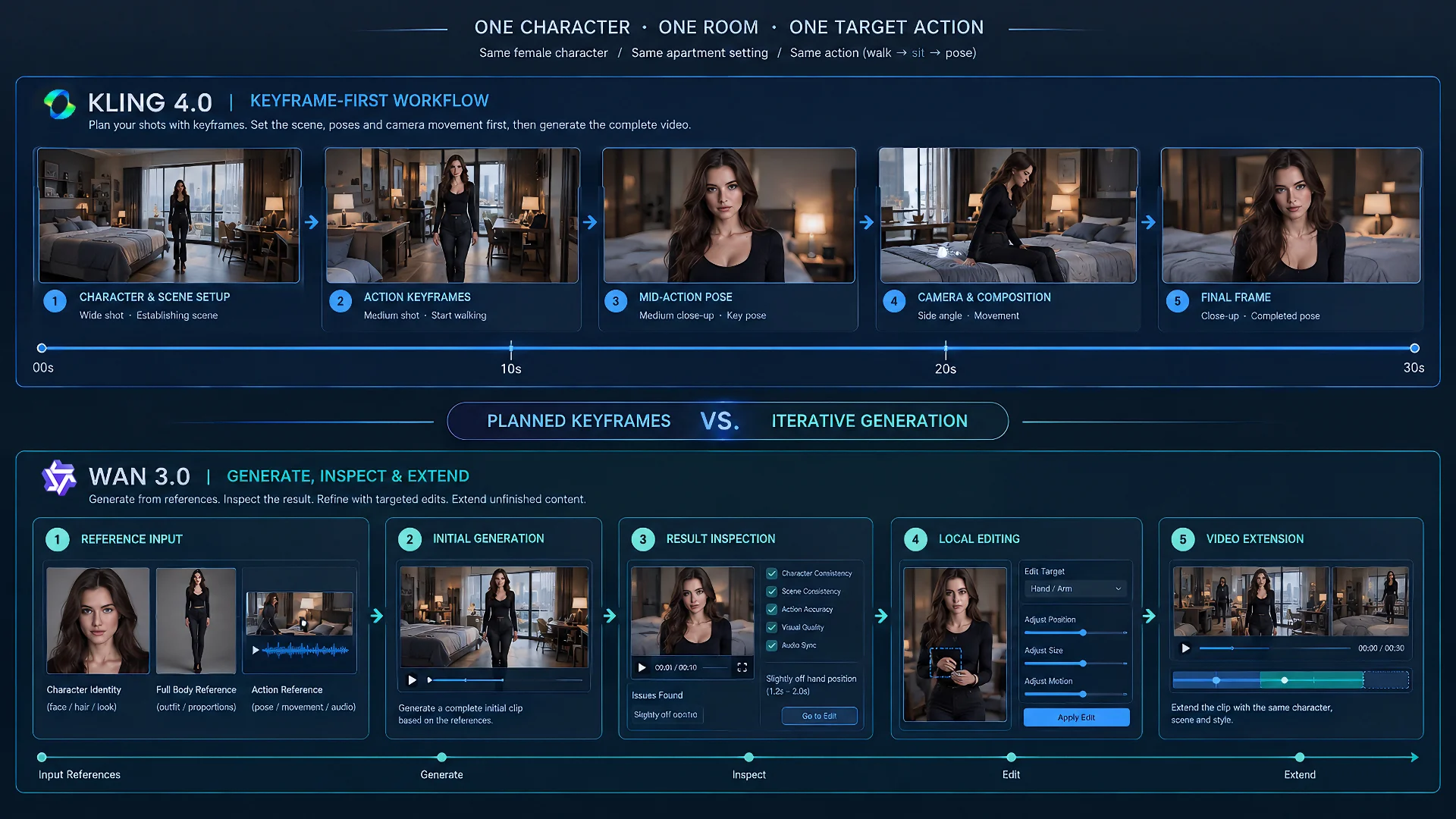
A keyframe tells the model what the video should look like at a particular moment. A reference tells the model what information should carry into a new video. Confusing these roles creates overloaded inputs and unstable results.
Choose Keyframe-Led Control When Timing and Composition Must Be Planned
Keyframes are valuable when specific visual states must happen in sequence. They can define where characters begin, how the framing changes, which pose belongs in the middle, and what the final composition should be.
This can help a multi-stage NSFW scene in which the order of movement matters. Instead of placing every instruction in one paragraph, the creator can provide visual targets for several points on the timeline. The model’s job becomes connecting those states with believable motion.
The method still depends on compatible frames. A keyframe sequence should preserve recognizable identity, proportions, wardrobe, location, screen direction, and light. If the third keyframe silently changes several of those details, the transition problem begins before generation.
Choose Reference-Led Control When Assets Have Different Jobs
Wan 3.0 supports references that can carry different kinds of production information.
A portrait can define identity. A wider character image can clarify body proportions and wardrobe. A short video can demonstrate motion or camera behavior. Audio can guide voice or sound direction. A location image can provide environmental context without becoming the exact opening frame.
The useful advantage is not the total number of uploads. It is the ability to assign a clear role to each one. Ten similar portraits may provide less usable information than one clear identity image, one full-body reference, and one motion example.
Reference-led generation also allows the composition to change. The source image does not always need to appear as frame zero. This makes it suitable when the same recognizable character should enter a new location, pose, camera angle, or story beat.
Creators who need that workflow can use NSFW Reference-to-Video to preserve character identity while restaging the scene.
The Decision Rule
- Use keyframes to control when and where important visual states happen.
- Use references to control which identity, motion, voice, environment, or style the model should reuse.
- Use standard image-to-video when the uploaded image should remain the actual opening composition.
- Use editing or extension when the current clip is already the most valuable source asset.
Kling 4.0 may combine more of these controls when it launches. Wan 3.0 already provides the reference, editing, and extension routes needed to apply this decision today.
What Happens After the First Generation?
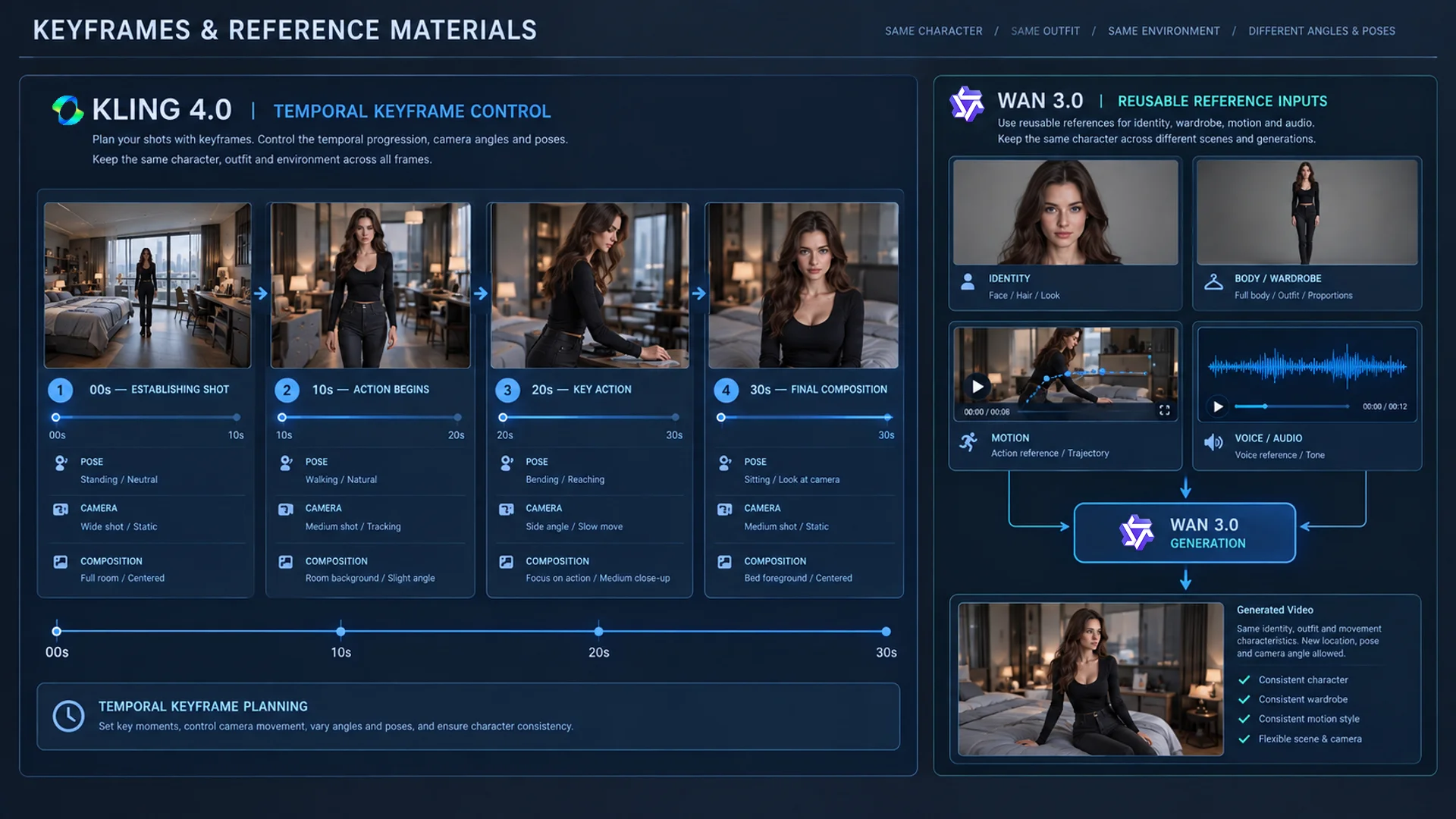
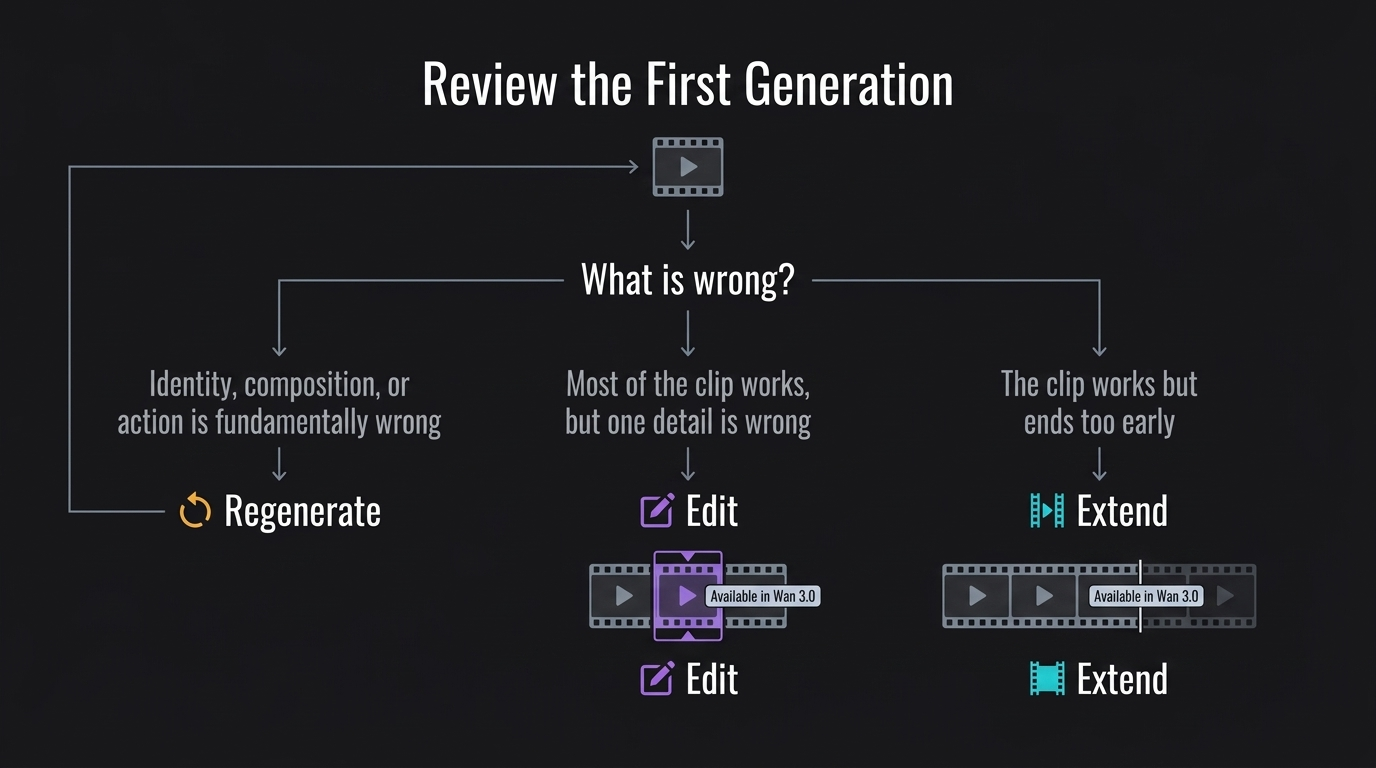
Many model comparisons stop after pressing Generate. Real production usually begins its most expensive decision at that point: should the creator regenerate, edit, extend, or keep the clip and fix the remaining issue in post-production?
Regenerate When the Foundation Is Wrong
Generate the scene again when identity, composition, action order, or camera direction is fundamentally incorrect. Trying to repair every frame of a clip built on the wrong opening state usually costs more effort than producing a cleaner version.
For Kling 4.0, that may mean simplifying the keyframe sequence, removing a contradictory reference, or assigning fewer changes to one 30-second generation. Its final editing controls need to be verified once the full release is available.
For Wan 3.0, it may mean returning to a clearer first frame, reducing competing references, or separating an overloaded scene into a generation followed by an extension.
Edit When Most of the Clip Is Already Correct
Editing makes sense when the character, action, camera, and timing are usable but one element is wrong. The target might be wardrobe, lighting, a background object, dialogue, or another localized part of the video.
Wan 3.0 can take the existing video as input and apply an editing instruction while also using image or audio references. The value is preservation: the creator does not have to sacrifice an otherwise successful performance to change one production detail.
Kling 4.0 has announced enhanced video editing, but its exact public controls and behavior should be checked at launch. Until then, it is a planned capability rather than an established reason to leave a working Wan workflow.
Extend When the Direction Is Correct but Incomplete
Extension is appropriate when the clip ends before the intended reaction, movement, transition, or final pose. The new segment should begin from the actual state at the end of the existing video, not from a fresh description of the original scene.
Wan 3.0 supports forward, backward, and bidirectional extension within a total-duration limit. That makes extension part of the current workflow rather than a separate promise.
Kling 4.0 also lists video extension among its announced capabilities. The meaningful launch question is not whether an Extend button exists. It is whether the extension preserves identity, audio, location, motion direction, and scene state across the join.
This post-generation layer is where Wan 3.0 currently has the clearest practical advantage. Kling 4.0 may match or exceed it, but that decision needs released controls and finished outputs rather than announcement language.
Which Workflow Better Handles Difficult NSFW Scenes?
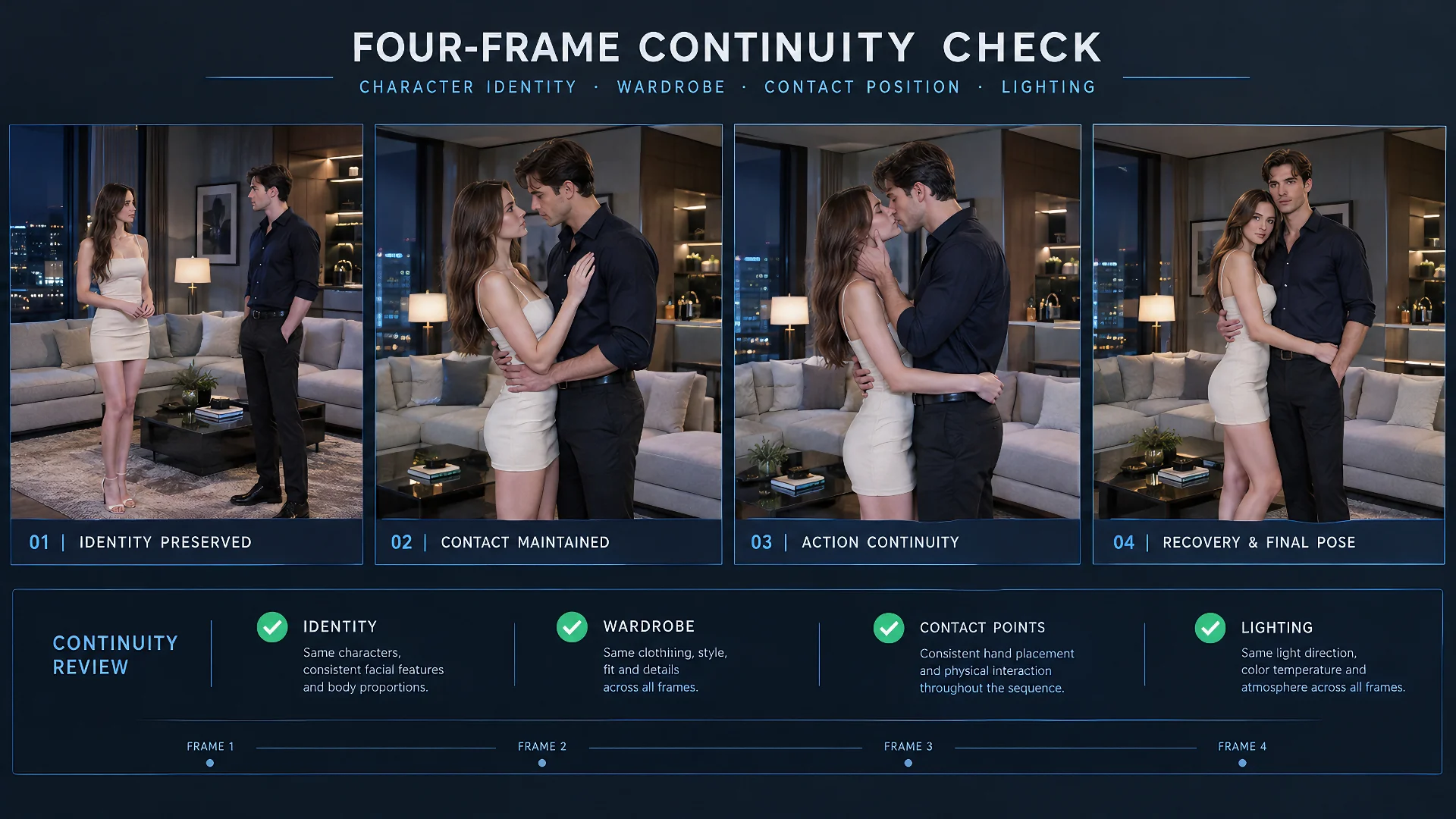
NSFW scenes often create a more demanding spatial problem than a single character walking or speaking to camera. Two characters may overlap, limbs may cross, clothing may move, one body may hide another, and a close camera can make small geometry errors immediately visible.
Neither a reference count nor a keyframe count proves that a model can solve those conditions. The useful comparison is how each workflow lets the creator define, diagnose, and recover from them.
Identity After Occlusion
When one character turns away, moves behind another person, or leaves the center of the frame, the model must reconstruct hidden information later. The result should return to the same face, hairstyle, body type, and distinguishing details.
Kling 4.0 keyframes could anchor identity again after an occlusion. Wan 3.0 can combine identity references with the intended action and use a previous clip as material for editing or continuation. Which method performs better requires matched tests.
Contact and Position
The scene should maintain who is on the left or right, which character initiates the movement, and where each person is supposed to end. Hands and limbs should connect to the correct body throughout the action.
A useful keyframe sequence can define several stable poses, but incompatible body positions may force an unnatural transition. A useful Wan reference package can separate identity from motion guidance, but too many references can compete over pose and composition.
Camera Continuity
A model may hide a difficult transition by cutting to a close-up or introducing a new camera angle. That can produce an attractive clip while failing the requested continuous action.
Kling 4.0 Flash has already produced early reports of unrequested cuts, but Flash is not the full model and should not determine the final verdict. Wan 3.0 also needs explicit scene planning when a continuous take matters.
The correct test is whether the requested camera path survives without resetting identity or position.
Recovery After Failure
This is where workflow design becomes as important as raw model quality.
If the scene fails at second 18, must the entire 30 seconds be regenerated? Can the good opening be preserved? Can references be simplified? Can the ending be extended from a stable frame?
Wan 3.0 already gives creators several recovery routes. Kling 4.0’s launch value will depend partly on whether its keyframes and editing tools make failures more local and repairable rather than merely producing more ambitious first attempts.
Content Access Can Change the Winner
For an NSFW workflow, model performance matters only after the project reaches the model.
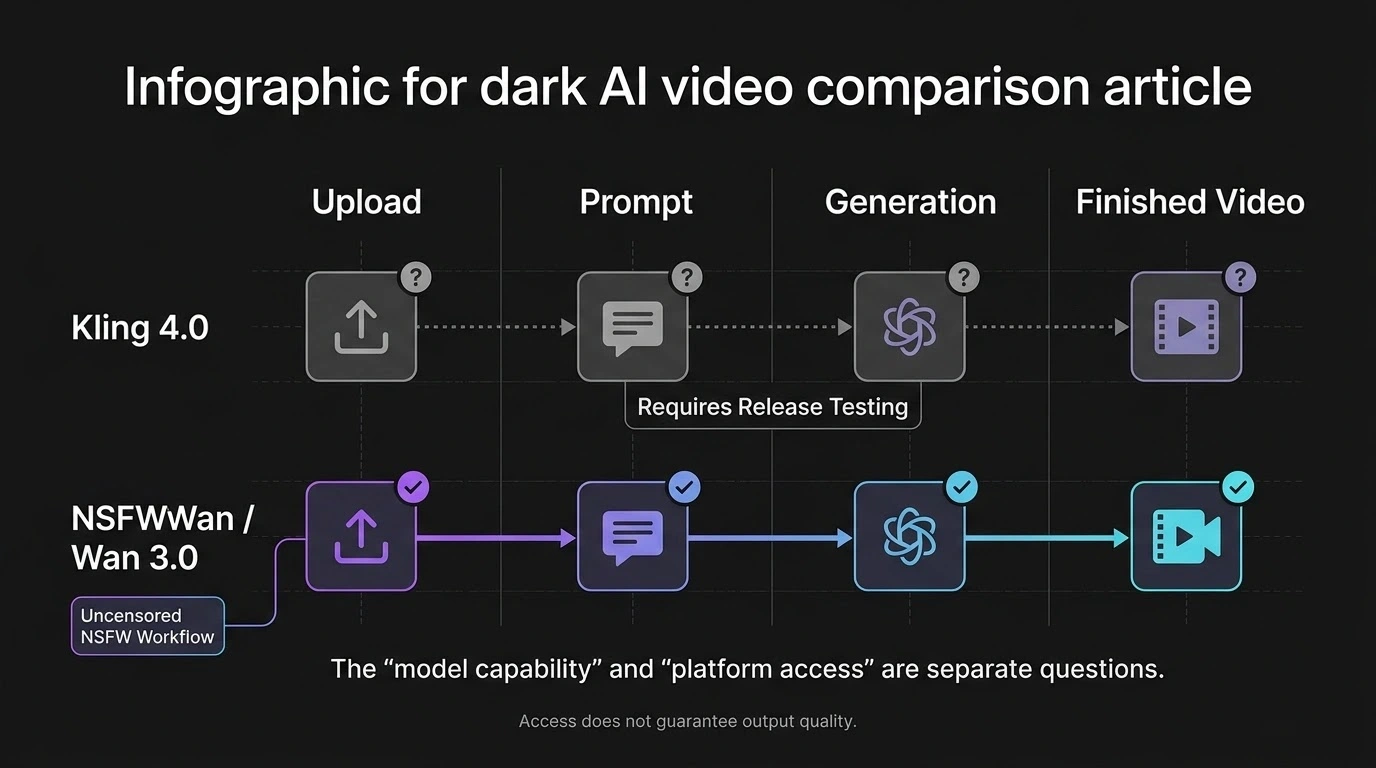
Content access should be evaluated at four separate stages:
- Upload: Does the platform accept the source image or video?
- Prompt: Can the intended scene be described and submitted?
- Task completion: Does the generation finish rather than fail during a later moderation check?
- Output fidelity: Does the final clip preserve the requested content instead of changing wardrobe, avoiding the central action, or cutting away from it?
Kling’s existing consumer service has generated repeated user complaints about mature-content filters and false positives. The Kling 4.0 announcement describes new creative capabilities but does not establish an uncensored mode.
Until the full release is tested, Kling 4.0 should not be presented as a confirmed NSFW generator.
Wan is not tied to one interface or moderation policy. The same underlying model family can appear in an official service, a third-party host, a local workflow, or a specialized platform. Those routes may accept different inputs even when they use related model technology.
On NSFWWan, Wan 3.0 NSFW is available through a browser-based uncensored workflow. Creators can evaluate the model’s actual ability to follow mature scenes without first routing the request through a broad mainstream prompt gate.
This does not guarantee perfect anatomy, motion, or prompt adherence. It changes which problem the creator is solving.
Instead of trying to make the request enter the system, the creator can focus on references, scene design, motion, continuity, and revision.
That difference can outweigh 4K output or a larger keyframe count. A model that cannot accept the intended project is not the better production choice for that project.
Wait for Kling 4.0 or Use Wan 3.0 Now?
Use Wan 3.0 Now
Choose Wan 3.0 when the project needs to move now, when mature source material must be accepted, or when the first generation is only one stage of the workflow.
It is also the stronger current choice when editing and extension are more valuable than native 4K delivery.
The most suitable users include creators with existing character assets, users building several clips around the same identity, and productions that expect to preserve good footage while changing or continuing specific parts.
Wait for Kling 4.0
Wait when multi-keyframe control solves a requirement that cannot be handled efficiently with first/last frames, prompt timing, or a reference-led Wan workflow.
Kling 4.0 may also be worth waiting for when the final delivery genuinely requires 4K HDR or when multilingual audio performance is central to the finished scene.
Waiting does not mean assuming Kling 4.0 will be better. It means preparing a matched test with the same characters, action, duration, and review criteria.
The released model must still prove identity continuity, camera obedience, editability, and compatibility with the intended content.
Use Both as Different Production Routes
Some creators will not need one permanent winner.
Kling 4.0 may become useful for carefully storyboarded scenes with several controlled milestones, while Wan 3.0 remains useful for uncensored reference-led generation, repair, and extension.
That is a more realistic workflow decision than forcing every scene through one model. Choose by the job the scene needs completed.
Frequently Asked Questions
Does Kling 4.0 replace Wan 3.0?
No. The models overlap on duration, references, audio, editing, and extension, but their workflow emphasis differs.
Kling 4.0 highlights multi-keyframe direction and high-resolution delivery. Wan 3.0 currently provides an available all-in-one route for generation, references, editing, and extension.
Which model is better for a 30-second NSFW scene?
Wan 3.0 is the usable choice today because it is available through an uncensored NSFWWan workflow.
Kling 4.0 may become attractive for scenes that benefit from several planned keyframes, but its NSFW access and full-release performance remain unconfirmed.
Should I use keyframes or character references?
Use keyframes when exact poses, compositions, or scene states must occur at specific moments.
Use character references when identity should remain recognizable inside a newly staged composition. A production may use both, but every asset should have a distinct role.
Which model is better when the first result needs correction?
Wan 3.0 currently has the clearer documented workflow because it can edit or extend an existing result.
Kling 4.0 has announced editing and extension, but its released controls and preservation quality still need verification.
Is Kling 4.0 uncensored?
No uncensored Kling 4.0 mode has been confirmed. Its announced generation features should not be treated as evidence of a change to mature-content restrictions.
Final Takeaway
Kling 4.0 and Wan 3.0 are not separated by duration alone. The more useful distinction is where control enters the production.
Kling 4.0 promises more control before generation through multi-keyframe direction, up to 15 multimodal references, and 4K HDR delivery.
Wan 3.0 already provides control across the wider production cycle: generate from multiple input types, review the result, edit what is wrong, and extend what is incomplete.
For NSFW creators, content access makes that workflow difference even more important. Wan 3.0 is available now on NSFWWan through an uncensored route. Kling 4.0 should be tested after release when its keyframes, editing controls, and content restrictions can be evaluated on finished scenes rather than announcements.
Start Creating With Wan 3.0 NSFW